
Some Rooms
Don’t Need
More Light.
They Need the
Right Light.
When the Client Says
“Keep It Simple,”
That’s the Hard Job.
Any production company can fill a room with gear. Load in the truss, blast the LEDs, point some movers at the ceiling and call it a night. That is easy. What is genuinely difficult — what requires real artistry and restraint — is walking into one of the most storied rooms in Music City and deciding what not to do.
The client brief for the Parallax Exchange 2018 corporate gala was deceptively short: keep it simple. The venue said the rest. Grand Ole Opry Studio A has hosted television broadcasts, live performances, and recordings that shaped American music. Decades of history live in those walls. Our job was not to decorate the room. Our job was to honor it.
The Venue — Grand Ole Opry Studio A, Nashville
Studio A is one of Nashville's most legendary performance and broadcast spaces — a room where Music City's history isn't just remembered, it's felt. When you produce an event here, the venue is your co-designer. The right production leans into that. The wrong one fights it.
The goal wasn't a production you noticed. It was a production you felt without knowing why.
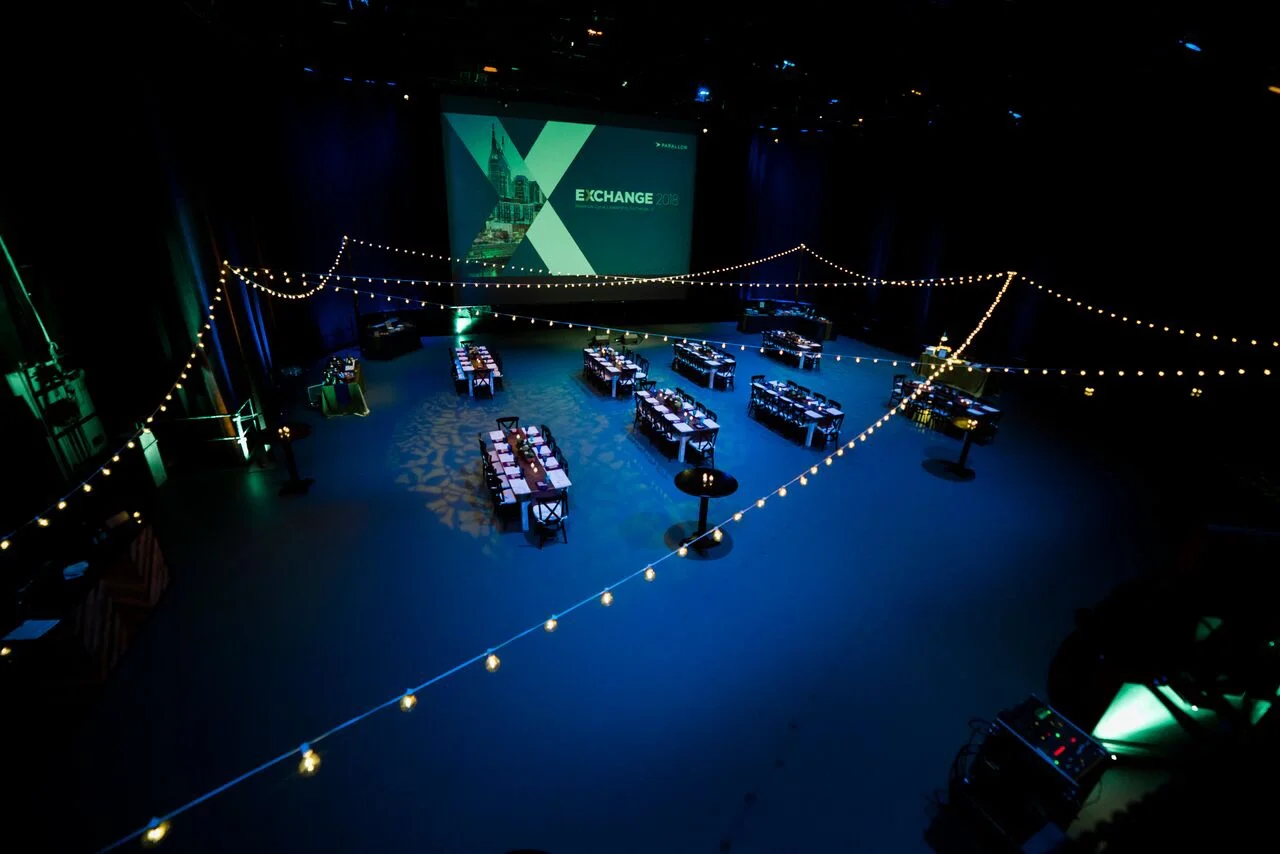
— Nashville Audio Visual production teamWe started from the ceiling. Runs of incandescent Edison string lights were installed in sweeping diagonal lines overhead — not packed tight like a canopy, but spaced with intention, the warm amber glow of each individual bulb tracing geometry across the black above the guests. No LED substitutes. No cool-white festoon. Incandescent only, because incandescent is the color of Americana. It is the color of a front porch in July, of a roadhouse at midnight, of every iconic Nashville stage photograph ever taken. It was the right tool for this room.
Why Incandescent String Lights?
LED string lights are efficient and long-lasting — but they produce a fundamentally different quality of light. Incandescent bulbs emit a warm, continuous-spectrum glow that photographs beautifully and reads as genuinely warm to the human eye. In a venue with historical and emotional weight like Studio A, the difference between incandescent and LED is the difference between feeling something and just seeing it lit up. We always spec incandescent when the room calls for soul.
On the floor, we deployed gobo projections — custom-cut metal templates dropped into ellipsoidal fixtures — throwing intricate patterned light across the concrete and the tablecloths below. The patterns were soft, organic, almost botanical: the kind of texture that makes a room feel curated rather than produced. Combined with a deep blue ambient wash bathing the floor from uplights, the result was a room that looked painted, not illuminated.
What Is a Gobo?
A gobo (short for "go between") is a thin metal or glass template that slides into the gate of an ellipsoidal spotlight. When light passes through the cutout pattern, it projects that shape — a leaf, a lattice, a logo, a geometric form — onto any surface: floors, walls, draping, even people. Gobos are one of the most powerful and underused tools in event lighting. A single gobo-equipped fixture can transform a blank concrete floor into something that looks like it took days to design. We sized and aimed ours to interact with the table layout, so the patterns fell between the place settings like they'd always been there.
The large-format projection screen behind the stage ran the Parallax Exchange branding — but at exactly the right brightness. This is where most productions get it wrong. They set the projector to full output and blow out the ambient atmosphere they spent hours building. We dialed the projection output down deliberately, treating it as another layer of the lighting design rather than a separate AV element. The teal and graphite presentation graphics glowed rather than blasted, becoming part of the room's color palette instead of fighting against it.
DMX Dimming — The Art of Less
DMX (Digital Multiplex) is the control protocol that governs nearly all professional event lighting. Every fixture — string lights, uplights, ellipsoidals, moving heads — can be assigned a DMX address and controlled from a single console. This allows a lighting designer to set precise intensity levels for every source in the room simultaneously, and to shift those levels smoothly as the evening progresses. For this event, DMX dimming was everything. The string lights ran at 72%. The floor wash sat at 35%. The projection content was matched to the ambient level so nothing overpowered anything else. That balance is what made the room feel effortless. It didn't happen by accident.
The result was a corporate dinner that felt like it belonged to Nashville rather than just happening in it. Guests walked in and stopped talking. That pause — that moment of taking in a room — is the thing you're actually paying for when you hire the right production company.
The Room Did the Talking.
We Just Set the Stage.
Grand Ole Opry Studio A didn't need a production company to make it special. It needed one that understood that. Restraint, precision, and a deep respect for what the room already was — that is the Nashville Audio Visual approach to historic Nashville venues.
Producing an Event at a Historic Nashville Venue?
We know these rooms. We know what they need — and what they don’t. Let’s talk about your event.
Start the Conversation