
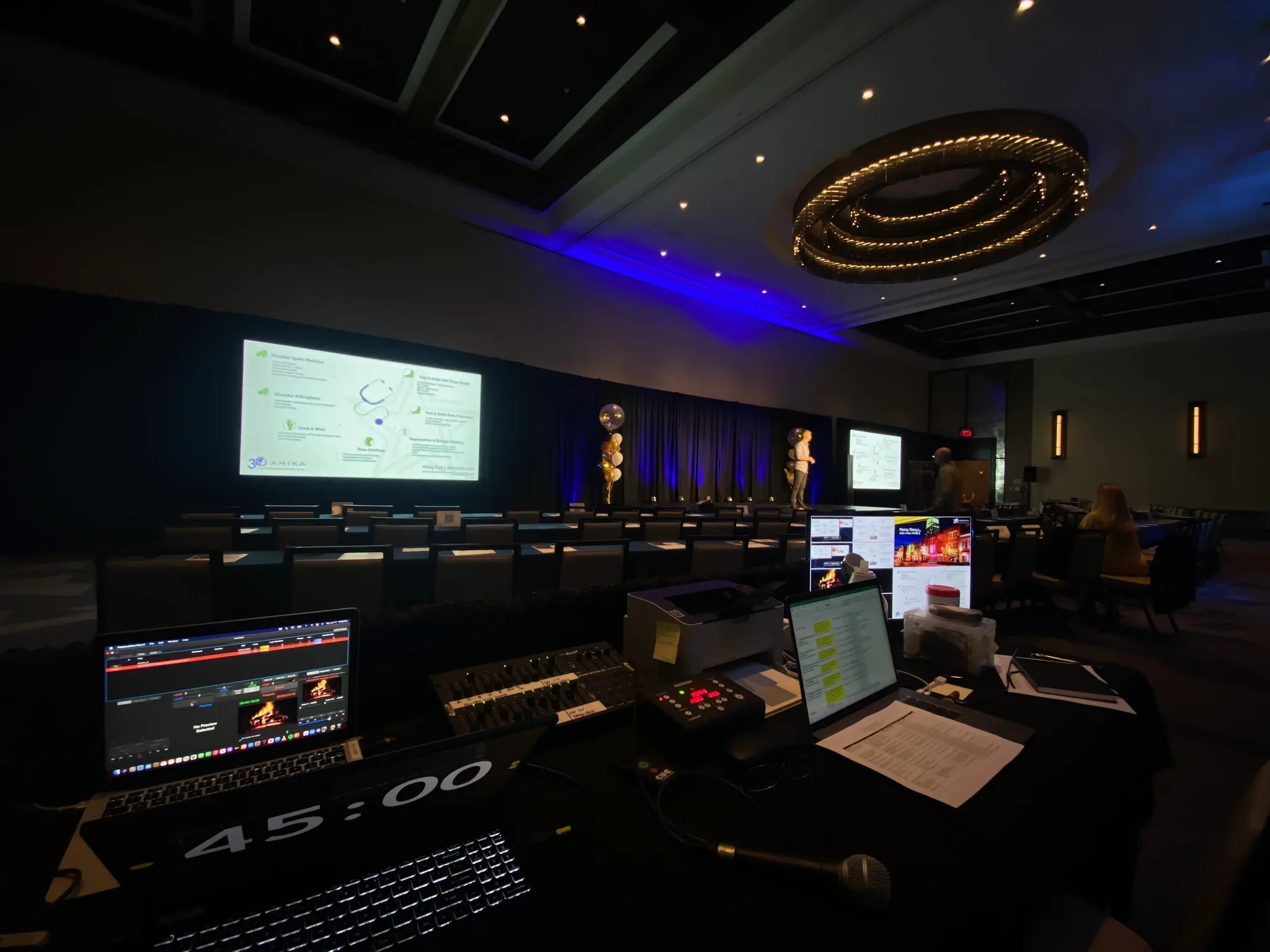
You've been to a polished corporate conference, a hotel ballroom gala, or a big outdoor production and thought — how does all of this just work? The short answer: a lot of people, a lot of planning, and more cable than most people see in a lifetime. The longer answer is what this post is about. Here's how Nashville Audio Visual takes a large-scale event from the first phone call to the moment the last case rolls onto the truck.
The Initial Reach
It usually starts with an email or a phone call. An event planner, a corporate communications director, or a hotel contact reaches out with a vision — sometimes detailed, sometimes just a vibe. From that first conversation, we're already building the picture in our heads.
What's the room? How many attendees? Are there multiple stages or breakout rooms? Is the CEO presenting? Is there live music? A panel? A gala dinner? Every answer changes the scope — and the gear list.
If the event is large enough, we do a site walk. We measure sight lines, check ceiling heights for rigging, locate power distribution panels, and figure out where the FOH (front of house) position will live. We're not just planning — we're solving problems before they can happen on show day.
Pre-Production: Where Events Are Really Made
The event happens once. The pre-production happens for weeks. This is where Nashville Audio Visual earns its money before anyone steps on stage.
- Run of Show — A minute-by-minute script that every department works from. When the video rolls. When the lights shift. When the mic gets handed off. Everyone follows the same document.
- Channel Planning — Every wireless mic, IEM (in-ear monitor), and comms device gets assigned a frequency. In a dense radio environment like a hotel ballroom, frequency coordination is a science, not a guess.
- CAD Drawings — For large productions, we draw the stage, the screen positions, the speaker positions, the lighting rig. The client can visualize it. The crew can build it.
- Crew Assignments — Who runs audio. Who runs video. Who manages the stage. Who handles wireless. Everyone knows their role before the trucks leave the warehouse.
Load-In: The Day Chaos Becomes Order
The trucks arrive early. Sometimes very early. A large ballroom production might start load-in the day before the event — staging companies building risers, lighting crew hanging fixtures from the ceiling grid, audio team pulling cable runs from the stage to FOH position, video team assembling the LED wall panel by panel.
This is the part no one sees. It's also the part that determines everything. A clean load-in means a clean show. A chaotic load-in means you're troubleshooting when you should be doing sound check.
The Four Worlds — And How They Talk to Each Other
A large event has four distinct production departments. Each one operates independently — and every one of them depends on the others.
Audio World
The audio engineer at FOH controls what the audience hears. They're riding a digital console, managing 30+ channels — wireless lavs, handhelds, podium mics, playback tracks, video audio feeds, hearing loop sends. Behind the stage, a second engineer may be managing monitor mixes so speakers can hear themselves without turning around. Every wireless mic gets its own mix. Every speaker has different needs.
Video World
The video engineer controls what the audience sees — and what the presenter sees. The LED wall behind the stage runs content from a media server. IMAG screens on the sides of the room show the live camera feed of whoever is speaking, so attendees in row 50 get the same experience as row 1. Confidence monitors on the stage face the presenter so they can see their slides without turning away from the audience. It all routes through a video switcher — one operator, dozens of inputs, zero lag allowed.
Lighting World
The lighting designer programs every cue in advance and fires them in real time off the run of show. Stage wash for the keynote. Spotlights for the award recipients. Uplighting color shift for the dinner transition. A burst of haze and dynamic movement when the gala kicks off. The lighting console communicates with every fixture via DMX — a digital signal that tells each light exactly what to do, down to its color, position, and intensity, every fraction of a second.
Backstage & Stage Management
The stage manager is the person holding everything together. They're backstage with a headset, calling cues to audio, video, and lighting simultaneously. They're managing the green room, cueing speakers to the stage, handing off mics, tracking timing. When the CEO runs two minutes long, the stage manager is already adjusting the run of show in their head and communicating the change to every department — calmly, clearly, without the audience ever knowing.
All four departments stay connected via a Clear-Com intercom system — a hardwired or wireless belt pack and headset on every key crew member. When audio needs to fade for a video roll, lighting needs to know. When video is going to a live camera, audio needs to be ready. When the speaker is walking on stage, everyone is hearing the same cue at the same moment. It's a constant quiet conversation that the audience never hears.
Mic World: The Art of Wiring a Human Being
Wireless microphones are where production meets intimacy. There are three common types used in large event production:
- Lavalier (Lav) Mic — A small clip mic worn on the body. Typically hidden in the collar, tie, or chest area. The transmitter (belt pack) clips to the waistband or sits in a jacket pocket. Placement matters enormously — the wrong spot creates clothing rustle, muffled audio, or a hot spot when the speaker turns their head.
- Handheld Wireless — The classic mic. Great for Q&A, awards presenters, emcees. Quick to hand off, easy to use, everyone knows how to hold one.
- Podium Mic — Wired or wireless gooseneck on the lectern. Rock solid, no batteries to die, ideal for formal presentations.
Wiring a presenter before a major keynote is a ritual. We clip the lav, run the cable, tuck the transmitter, test the levels, and confirm the frequency is clear — all while the presenter is trying to review their notes and not think about the 500 people waiting for them on the other side of a curtain. Calm, fast, invisible. That's the job.
Passing Mics & The Catchbox: Q&A Done Right
Q&A sessions are where mic management gets creative. In a room of 300 people, you have two options: send a runner sprinting through the aisles with a handheld, or throw the mic.
We use the Catchbox — and if you haven't seen one, you're about to love it.
The Catchbox is a soft foam cube wrapped around a wireless microphone transmitter. You literally throw it to the audience member asking the question. They catch it, speak into it, and throw it back (or to the next person). The mic auto-mutes when it's in the air so you don't get a burst of wind noise over the PA, and unmutes the moment it's caught. It sounds like a gimmick. It works like a tool. Audiences love it — it breaks the formality of a Q&A and turns audience participation into something genuinely fun.
For more formal settings — panels, award ceremonies, black-tie galas — the runner-with-handheld approach is still the gold standard. Two runners, two mics, choreographed around the room. No throws required.
Show Day: The Run of Show Is Law
When the doors open, the production team has been there for hours. Everything has been tested. The wireless mics have been scanned. The LED wall has been calibrated. The lighting cues have been programmed. The stage manager has walked every presenter through what happens when they step on stage.
The run of show is the document everyone lives and dies by. It lists every moment of the event, down to the second — when the video rolls, when the presenter walks on, when the lights change, when the band starts. During the show, the stage manager calls every cue through the comms, and every department executes.
Things will not go exactly as planned. A speaker will skip a slide. The panel will run long. A wireless mic will drift frequency in a crowded RF environment. This is why experience matters — not to prevent problems, but to solve them in real time without the audience ever knowing something happened.
Strike: The Art Nobody Sees
The moment the last attendee walks out, the production team walks in. Cases come out, cable gets coiled, fixtures come down, the LED wall gets deconstructed panel by panel. A room that took eight hours to build gets struck in two. Every piece of gear gets inventoried, packed, and loaded onto the truck exactly the way it came off — because there's another show next week, and it needs to be ready.
30 Years of Making It Look Easy
Nashville Audio Visual has been running large-scale events in Music City since 1995. Corporate conferences at the Gaylord Opryland. Hotel galas at the JW Marriott. Outdoor productions in the Nashville summer heat. The technology changes. The process — first call, pre-production, load-in, show, strike — stays the same. And the goal never changes: your audience walks out impressed, your client walks out relieved, and everything that made it work stays invisible.
Planning a Large Event in Nashville?
Tell us about your event and we'll build a production plan that makes every seat the best seat in the room.
Get a Free Quote