
March 12, 2020. The NBA suspended its season. SXSW was cancelled the week before. By the end of that week, every Nashville ballroom calendar from Music City Center to the Omni had a red line drawn through it. Conferences postponed. Weddings rescheduled. Concert tours pulled off the road mid-leg. For the live event industry, the lights didn’t just dim — they went out.
The numbers got brutal fast. Pollstar reported the top 100 concert tours of 2020 grossed 96% less than 2019. The #WeMakeEvents coalition estimated roughly 12 million live-event workers globally lost their primary income overnight, with around a million of them in the United States. Industry surveys from organizations like ESTA and AVIXA showed AV companies contracted, on average, somewhere between 60% and 80% of headcount in the months that followed. Some of the biggest names in production went bankrupt. Many that survived did so by trimming their crews in half — or more.
At Nashville Audio Visual, we made a different call.
We Kept Everyone. Every Single Person.
Not most of the crew. Not the senior folks. Not just the salaried staff. Everyone. The FOH engineers. The monitor techs. The lighting designers and the board ops. The video engineers and the camera operators. The riggers, the shop hands, the warehouse team, the truck drivers, the dispatch crew, the office staff. The whole family.
That decision wasn’t easy and it wasn’t cheap. We made it with our eyes open about what it would cost. But we’ve been in business since 1995 because the people in the shop are the company — the gear in the warehouse only matters because someone knows how to make it sing. Letting that knowledge walk out the door to save a quarter’s payroll would have cost us more than the payroll itself. So the answer was simple: figure out how to make it work, and don’t lose a single person doing it.
What Do You Do When the Stages Go Quiet?
You get sharper.
With our trucks parked and the calendar wide open, we turned the warehouse into something between a graduate school and a laboratory. The work fell into three buckets:
1. We mastered the tech the post-COVID event would actually need.
In March 2020, the words “hybrid event” meant almost nothing to most ballroom AV crews. By the end of 2020, it meant everything. Every conference, every keynote, every annual meeting was suddenly expected to broadcast simultaneously to an in-person audience and a remote one — with the same production value, at the same time, with zero room for the stream to glitch in front of the CEO.
That’s a fundamentally different production discipline. It means running broadcast switchers as a primary deliverable, not a side feature. It means clean program feeds to RTMP endpoints (YouTube Live, Vimeo, Zoom Webinar, custom CDNs), separate audio mixes for the room and the stream, and confidence monitoring for remote presenters joining over a video call. It means understanding latency budgets across the whole signal chain. It means thinking about a viewer at home as a paying attendee, not an afterthought.
Our video and audio teams spent the dead months drilling that workflow. We built end-to-end dry runs in the warehouse — cameras to switcher, switcher to encoder, encoder to platform, presenter audio split off the FOH mix and ridden separately for the stream so the room and the broadcast both sounded right. By the time the doors opened, our hybrid-event pipeline was production-tested, not theoretical.
2. We learned the consoles the next generation of shows would run on.
Lighting and audio control surfaces went through more change between 2020 and 2022 than the prior decade combined. Our lighting designers spent that window deep inside the HOG 4 family, working through complex pixel-mapped show files for LED-heavy designs. Our audio engineers ran scenes and snapshots on our digital consoles the way you’d practice scales — gain structure, monitor mixes, wireless coordination across our Sennheiser G4 systems, and IEM workflows for performers who’d gone two years without a real stage.
We also rebuilt how we deploy speaker rigs. Our JBL VRX932LAP powered line arrays and QSC point-source systems got re-rigged, re-measured, and re-tuned for the rooms we work most often. When you can’t rehearse on a show, you rehearse for one — ours did, constantly.
3. We invested in new gear instead of selling off old gear.
The pandemic-era classified ads were full of bankrupt AV companies liquidating their inventories. Plenty of operators saw it as a chance to cash out. We went the other direction: where we could, we bought. We expanded our LED video wall inventory, added intelligent lighting fixtures, refreshed our wireless mic counts, and grew our Catchbox throwable mic stock so we could run a Q&A in a 1,500-seat ballroom without a runner sprinting up an aisle.
When the industry was shedding institutional knowledge and physical capacity at the same time, ours was compounding both.
The Payoff Showed Up Fast.
When in-person events came back in earnest in late 2021 and into 2022, a lot of AV companies were rebuilding from scratch. They were hiring green crews who’d never seen the gear before. They were sending one engineer who’d worked the rig alongside three who hadn’t. Production managers were spending their week re-teaching workflows their pre-COVID staff used to know cold.
We weren’t. Every person who walked into a NAV load-in in 2022 had walked into a NAV load-in in 2019. The chemistry was intact. The shorthand was intact. The trust between FOH and the lighting board and the LED tech and the video switcher was intact — because none of them had ever left. Show calls that other crews needed a rehearsal day to figure out, ours could execute on the first run-through.
And the technology we’d spent two years drilling? It became the baseline expectation. Every corporate annual meeting wanted a livestream. Every product launch wanted an LED video wall behind the stage. Every conference wanted multi-camera IMAG so the back of the room got the same experience as the front. Every wedding wanted a clean recording for the people who couldn’t fly in. The stuff venues across Middle Tennessee — Music City Center, the Gaylord Opryland Resort, the Omni Nashville, The Hermitage Hotel, Embassy Suites Nashville Downtown — now consider table stakes was the stuff our crew was already fluent in before the doors reopened.
What a NAV Show Looks Like Today, Because of It.
A typical mid-sized corporate event with us today might run something like this: an LED video wall behind the stage with custom motion graphics, three to four cameras feeding a broadcast switcher with IMAG to side-screens for the in-room audience, a clean program output simultaneously encoded to a private livestream for remote attendees, a wireless mic plot covering presenters and a panel, Catchbox throwable mics handling the audience Q&A, intelligent lighting cued to follow speakers and shift looks between agenda blocks, and a backstage com network connecting the show caller to every position in the room. One unified crew, one unified vision, no handoff seams.
That’s a show with maybe fifteen pieces of specialized gear and eight people who all have to read each other’s minds in real time. The reason it goes smoothly isn’t the gear — everybody can rent the gear. It’s the people who’ve been doing it together long enough that they don’t need to talk about it.
Thirty Years. One Family. Zero Layoffs.
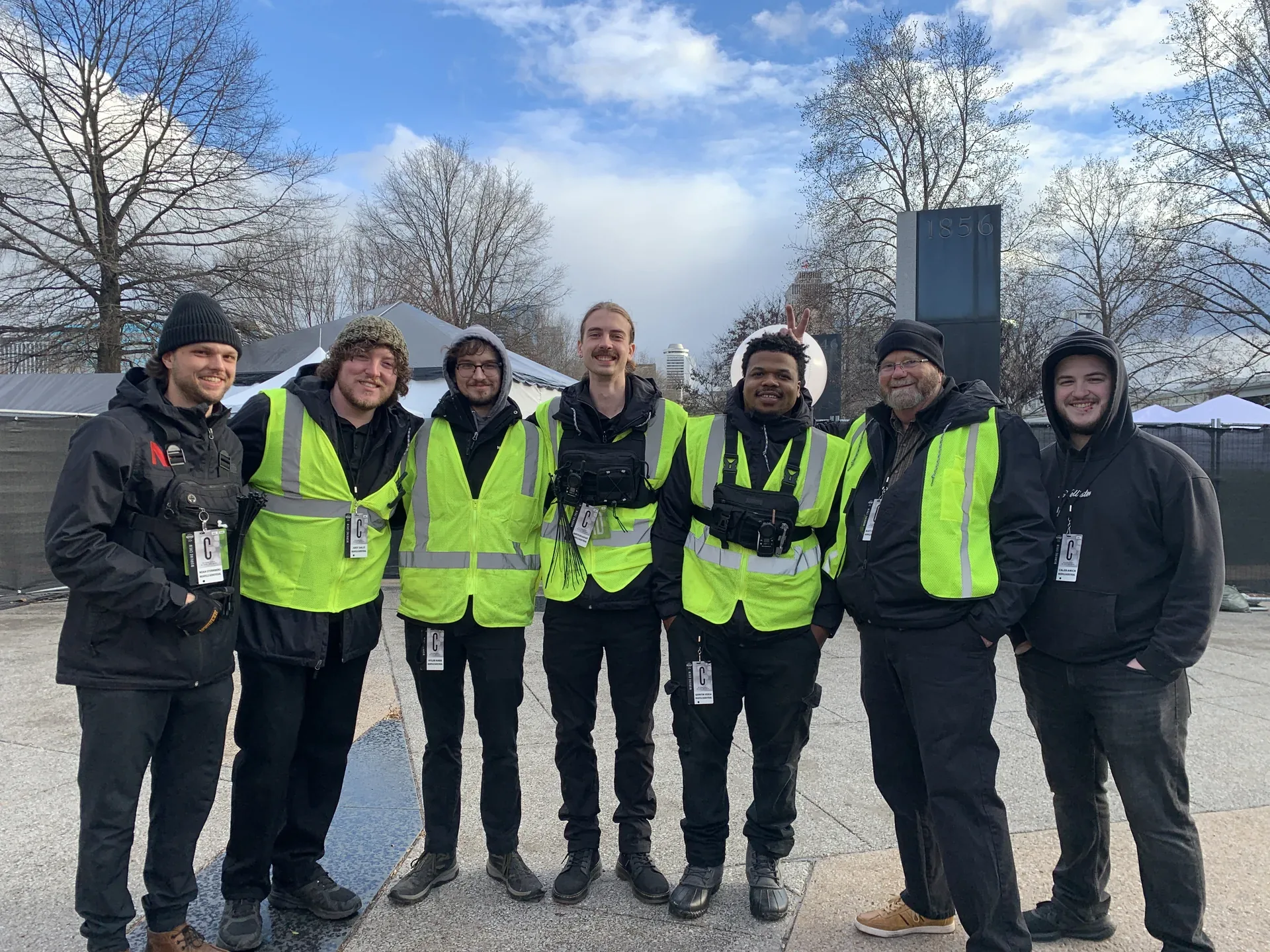
When you book Nashville Audio Visual, you’re not getting a rotating cast of contractors who learned the gear last quarter. You’re getting a crew that stood next to each other through the hardest stretch the live event industry has ever seen and came out the other side better at the job than they went in.
That’s not a marketing line. That’s the operational math. Continuity is a feature. Institutional memory is a feature. A crew that finishes each other’s sentences on a show call is a feature you cannot buy on short notice — you have to invest in keeping it intact when it’s expensive to do so.
Thirty years in Nashville. One family. Zero layoffs through COVID. And a deeper command of the technology shaping live events today than any of the companies who chose differently.
Got an event coming up? Let’s talk. You’ll be working with the crew that stayed — the same engineers, designers, and techs who’ve been doing it here since long before anyone said the word “hybrid.”