
By Nashville Audio Visual | June 18, 2026 | Event Production, Power & Networking
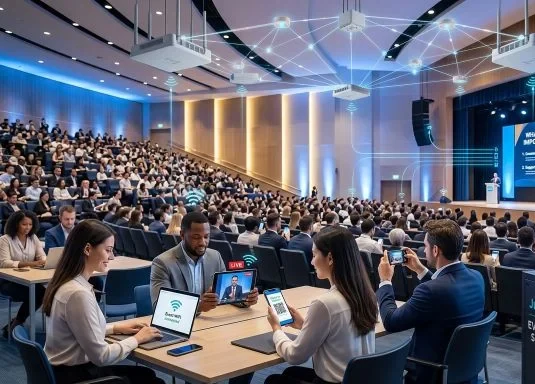
Here’s a fun party trick: walk into a 600-person general session, ask everyone to pull out their phone, and watch the venue’s “free guest WiFi” fall over like a folding chair in a mosh pit. The slide deck stalls. The live stream buffers. The cashless bar stops taking cards. And somewhere, a planner is whispering “but it worked in rehearsal” into a headset.
It worked in rehearsal because rehearsal had twelve devices on it. Showtime has a thousand. WiFi doesn’t scale by hope — it scales by math, hardware, and a network designed for the crowd you actually invited. So let’s talk about why the trusty router under the AV table can’t save you, why a mesh kit from the big-box store won’t either, and how we build event WiFi that holds the line when it counts.
The Hard Ceiling: One Router Taps Out at 253 Devices
Your typical router hands out addresses on one little neighborhood of the internet — the classic 192.168.1.x network. That neighborhood has exactly 256 house numbers. Knock off one for the “network” address, one for the broadcast address, and one for the router itself sitting at the front door, and you’re left with a hard cap of 253 devices. Device number 254 pulls into the parking lot and finds there’s literally nowhere to park.
The napkin math
256 addresses in a standard /24 network − 1 network − 1 broadcast − 1 gateway = 253 usable devices. One ballroom of guests, each carrying a phone, a smartwatch, and maybe a laptop, blows past that before the salad course.
Now, a real network engineer can hand out more addresses by opening up a bigger range — that part’s solvable. But here’s the kicker: addresses were never the real problem. Even if you had room for ten thousand devices, you’d hit a wall that no amount of clever numbering can fix. That wall is bandwidth.
And Even If It Could… There’s No Air Left to Breathe
WiFi isn’t a private wire to every guest — it’s one big conversation in one crowded room, and only one device can “talk” at a time. The more phones that want a turn, the more everyone waits. Engineers call it airtime contention; you experience it as the spinning wheel of doom.
It gets worse on the old 2.4 GHz band, which has only three non-overlapping channels (1, 6, and 11). Cram a crowd onto those and the signals step on each other like a three-person line dance in a phone booth. A single access point handles maybe 30–50 busy devices gracefully — not the 1,000+ a serious event throws at it.
- Shared, not switched — every client splits the same airtime, so density crushes throughput.
- Channel crowding — too many radios on too few channels means interference, retries, and drops.
- The hidden uplink — even perfect WiFi is throttled by the internet pipe behind it. 50 people on a live stream can saturate a small circuit instantly.
- Everything’s fighting — attendee phones, badge scanners, payment terminals, AV control, and your stream all want the same air.
Why a Mesh Network Just Won’t Do It
We love a good mesh kit — at home. For covering a two-story house with three tasteful little pucks, it’s genuinely great. But a mesh system is a minivan, and a 2,000-person event is the Daytona 500. Here’s where the minivan loses:
- Wireless backhaul eats your airtime. Most mesh nodes talk to each other over the same WiFi your guests are using — so every hop steals capacity from the crowd.
- No real RF planning. Mesh pucks pick channels on their own and often pick the same ones, manufacturing the exact interference you’re trying to avoid.
- No load balancing or fast roaming. When 400 people walk from the keynote to the breakout, consumer gear doesn’t gracefully hand them off — it clings, stalls, and drops.
- No segmentation. Your point-of-sale, registration, production, and guest traffic all share one undifferentiated soup. One streamer can starve the cash registers.
- Client ceilings. Mesh nodes are built for a few dozen devices, not the hundreds-per-zone a ballroom demands.
The professional answer looks different: hardwired access points fed by Ethernet (not wireless backhaul), controller-managed so they cooperate instead of compete, with deliberate channel planning, band steering to push capable devices to 5 and 6 GHz, fast roaming so people move without dropping, and separate networks (VLANs) that keep payments, production, and guest browsing in their own lanes — all sitting behind an internet uplink sized for the actual headcount.
Where Consumer WiFi Goes to Die
These are the rooms and fields where “we’ll just use the house WiFi” turns into a very bad afternoon — and where a real, engineered network earns its keep.
Large Hotel Ballrooms
Music City Center, Gaylord Opryland, Omni, JW Marriott — thousands of guests, concrete and steel killing signal, house WiFi never built for it.
Outdoor Events & Festivals
Fields, parking lots, rooftops, fairgrounds — zero infrastructure, so the whole network (and its power) has to be brought in and built.
Trade Shows & Expos
Hundreds of booths, each demanding its own connection for demos and payments. Density nightmares without segmentation.
Corporate Conferences & All-Hands
Live polling, audience Q&A, hybrid streaming, and breakout rooms all leaning on the network at once.
Cashless & Ticketed Events
When bars and gates run on cards and scanners, a dropped network isn’t an annoyance — it’s lost revenue at the door.
Broadcast & Press Areas
Media and streaming crews need guaranteed, dedicated bandwidth that the guest crowd can never touch.
Multi-Building Campuses
Events spread across halls, tents, and buildings need links that tie every zone together as one network.
Galas, Graduations & Sporting Events
Big seated crowds all reaching for their phones in the same ten seconds — the textbook density spike.
Meet the Guy Who’s Been Doing This Since Token Ring
A lot of AV companies will happily plug in a router and cross their fingers. We come at event networking from a different place — because our founder, Chris Jackson, spent years as a corporate network administrator long before “the cloud” was a marketing word. We’re talking real enterprise plumbing: tying multi-location companies together into one network, back when that meant leased lines, patience, and a deep respect for the OSI model.
Chris cut his teeth on Token Ring — yes, the one where a literal electronic “token” passed around the ring and you did not transmit until you held it (turns out the whole industry eventually agreed that politely taking turns has its limits). He ran Windows NT domains when NT was the new hotness, and kept the lights on in an AS/400 shop — IBM’s legendary midrange iron, green-screen 5250 terminals and all — wiring multiple corporate sites into a single, reliable network that simply had to stay up.
That background matters more than it sounds. Subnets, segmentation, bandwidth planning, routing between locations, keeping mission-critical traffic alive under load — the fundamentals haven’t changed, even if the cables got faster and the tokens went extinct. When we design WiFi for a thousand-person event, we’re not guessing. We’re applying decades of “this network cannot go down” discipline to a ballroom full of phones.
How We Actually Build Event WiFi That Holds
Great event WiFi is invisible — nobody notices it, which means it’s doing its job. Getting there is part engineering, part logistics, and (because the radios still need to be plugged in) part power and cable management. Here’s the playbook:
- Site survey & capacity plan — we map the space, count expected devices per zone, and calculate how many access points it actually takes (not how many fit in the budget by accident).
- Hardwired, managed access points — PoE-fed APs under a single controller, with planned channels and power levels so they cooperate instead of fight.
- Right-sized uplink — bonded venue circuits, dedicated fiber, or bonded cellular and satellite for the middle of a field.
- Network segmentation — separate lanes for guests, registration, point-of-sale, production, and streaming so nothing starves anything else.
- Cable, power & ramps — the same crew that runs your power distribution runs your data cable, protected under proper ramps and dressed clean.
- On-site monitoring — a technician watching the dashboards live, balancing load and squashing problems before your guests ever feel them.
It’s the same philosophy we bring to full event production: plan it to the detail, build it like it matters, and stand behind it on-site until the last guest logs off.
Got a Crowd Coming? Let’s Make Sure the WiFi Survives It.
Whether it’s a 2,000-person conference in a downtown ballroom or a festival in an open field with no power and no signal, Nashville Audio Visual designs, delivers, and runs event WiFi that doesn’t blink. Call 615-988-4554 or request a quote and tell us how many phones are coming.
Request a Free QuoteEvent WiFi FAQ
How many devices can one WiFi router really handle at an event?
In theory a typical home router hands out about 253 usable addresses on its default network — but in practice a single access point starts choking long before that, usually somewhere around 30 to 50 active devices. WiFi is a shared medium, so every phone, laptop, and payment terminal is competing for the same airtime. A 500-person ballroom can easily have 1,000+ connected devices once you count phones, watches, tablets, and staff gear. That is a job for many coordinated access points, not one box.
Why isn't a mesh WiFi system enough for a large event?
Consumer mesh kits are great for a house. At event scale they fall apart: most use wireless backhaul that eats the same airtime your guests need, they share channels instead of planning them, they don't do real load balancing or fast roaming, and they can't segment traffic. For a packed ballroom, a festival field, or a trade show floor, you need hardwired, controller-managed access points with proper RF planning and a real internet uplink behind them.
Do you provide the internet connection too, or just the WiFi equipment?
Both. WiFi is only the last few feet — the bottleneck is usually the uplink behind it. We plan and provision bandwidth to match your event: bonded venue circuits, dedicated fiber drops, or bonded cellular and satellite for outdoor sites with no infrastructure. Then we segment it so attendee traffic never starves your registration, point-of-sale, live stream, or production network.
Can you deliver WiFi for outdoor events with no existing network?
Yes — outdoor is exactly where consumer gear and venue house WiFi give up. We bring temporary uplinks, point-to-point wireless bridges, weatherized access points, and the power distribution to run it all, so a field, parking lot, or rooftop gets the same reliable coverage as a wired ballroom.
How far in advance should we plan event WiFi in Nashville?
For large or mission-critical events (cashless payments, live streaming, hybrid meetings), reach out 4 to 8 weeks ahead so we can do a proper site survey, capacity plan, and bandwidth order. Smaller setups can come together faster — call 615-988-4554 and we'll tell you honestly what your timeline allows.