
By Nashville Audio Visual | July 5, 2026 | Lighting Services
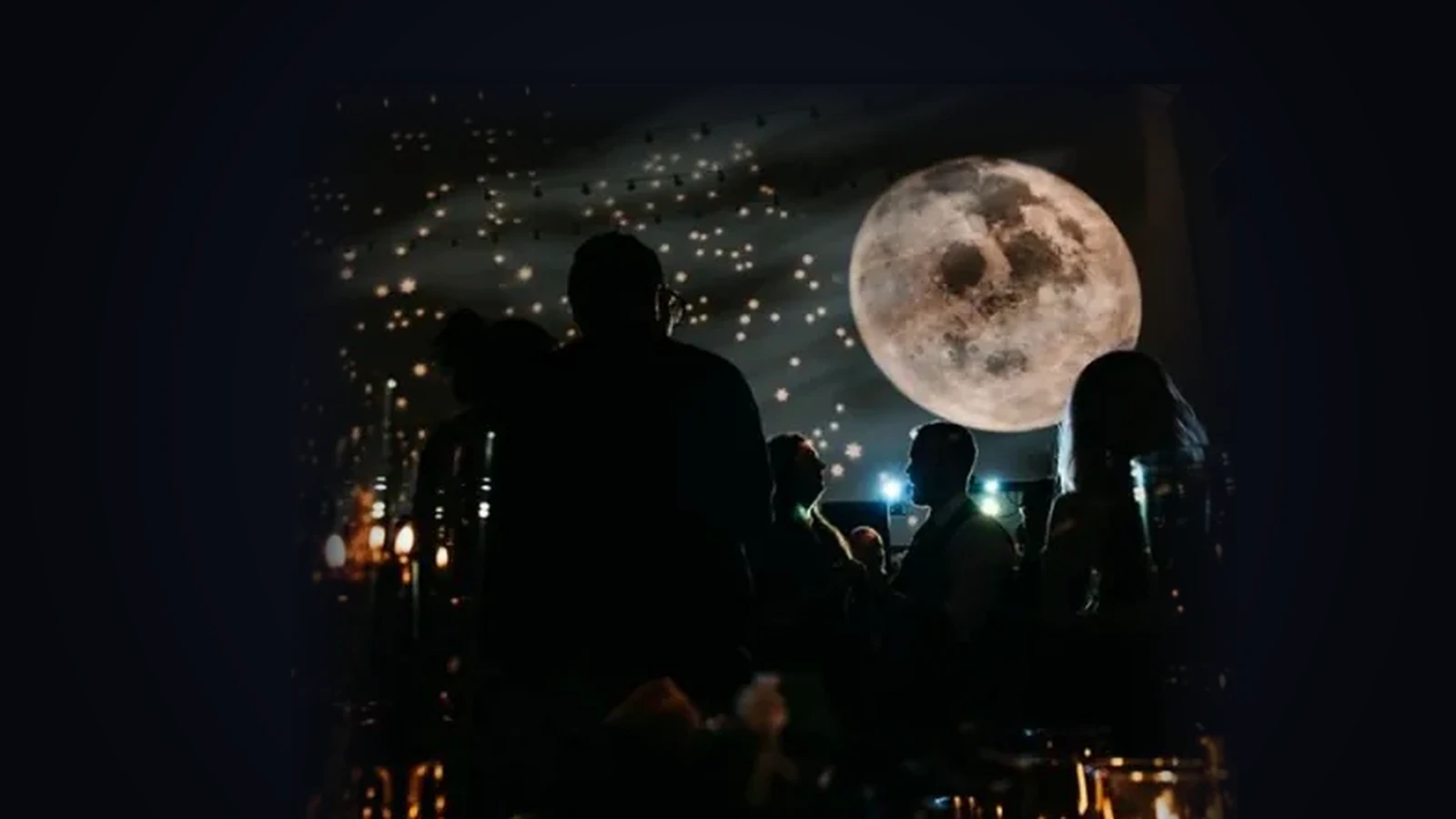
See that moon? The one hanging over the room like the closing shot of a movie, craters and all, with a scatter of stars drifting across the ceiling? Nobody wheeled in a twelve-foot balloon. That is a single light fixture, one small disc of glass, and about a hundred years of a trick called the gobo — and it is quietly one of the most powerful tools in event lighting.
Gobos come in two flavors: steel and glass. People love to ask which one is “better,” and the honest answer is the annoying one — it depends on what you’re trying to put on the wall. But if you want to understand why glass can paint you a photorealistic moon and steel simply can’t, and when the humble steel disc is still the smarter call, pull up a chair. This is the good stuff.
First, What Even Is a Gobo?
A gobo is a little template that drops into the “gate” of a focused light — right at the point where the beam is narrow and sharp, just before the lens. Light shoves through the open areas, the lens focuses it, and whatever shape you cut or printed lands on the wall as a crisp projected image. The name is most often traced to goes before optics, which is exactly where it sits — the full backstory is in what is a gobo.
That’s the whole magic trick. A monogram over the head table, a company logo washing across a stage, dappled leaf shadows turning a ballroom into a forest, a starfield, a snowflake storm, or a full moon — all of it is light squeezed through a patterned disc the size of a drink coaster. The only question that matters is what that disc is made of.
Steel Gobos: The Unkillable Workhorse
A steel gobo is a stencil, plain and simple. Start with a thin sheet of stainless steel, then chemically etch or laser-cut the metal away everywhere you want light to pass through. What’s left is a silhouette. Light pours through the gaps and projects that exact shape — in one single color, the color of the lamp or whatever gel you put in front of it.
That one-color limit is the whole personality of a steel gobo, and it’s not a knock — it’s a superpower for the right job. Steel is cheap, fast to produce, and basically indestructible. It laughs at heat, survives being dropped in a road case for a decade, and comes out looking brand new. There’s one quirk: because it’s a physical cut-out, any “floating” piece — think the middle of an O or the dot on an i — has to be held in place by tiny bridges of metal. A good designer hides them, but they’re the price of admission.
Steel is the right call for:
- Single-color logos, monograms & text — crisp, classic, and razor-sharp.
- Breakup & texture patterns — leaves, clouds, waves, geometric washes over a whole room.
- Tight budgets and fast turnarounds — you can have a custom steel gobo cut quickly.
- Rough conditions — outdoor rigs, hot fixtures, heavy touring abuse.
Glass Gobos: The Powerhouse
Now flip to glass, and the whole game changes. A glass gobo isn’t a stencil — it’s much closer to a photographic slide. The image is printed and coated onto a disc of heat-resistant borosilicate glass in multiple precise layers. Because you’re printing an image instead of cutting one, every limitation of steel evaporates:
- Full color — not one color, but all of them, in a single projected image.
- Smooth gradients — the soft glow around the moon, a sunset, a fade from deep blue to black.
- Photo-real detail — craters, clouds, water, brushed metal, a real photograph.
- No bridges, ever — isolated shapes and hairline detail float freely, because nothing is holding metal together.
The richest glass gobos use dichroic coatings — the same wizardry behind those color-shifting camera filters. Instead of absorbing light to make color (which fades and gets muddy under a hot beam), dichroic glass reflects specific wavelengths, so the color stays jaw-droppingly saturated even when you fire an intense light straight through it. That’s why a glass-gobo moon glows like it’s lit from within instead of looking like a washed-out slide.
So Why Is Glass “More Powerful”? Look at the Moon.
Go back to that moon at the top of the page and try to imagine building it out of steel. You can’t. A steel gobo could give you a flat white circle — a hole in a piece of metal. What it could never give you is the gradient from bright limb to shadowed edge, the thousands of craters in soft grayscale, the faint halo bleeding into the dark, and the delicate scatter of stars, each a tiny floating point of light with no bridge to hold it. Every one of those things is a job only glass can do.
That’s the real headline: steel projects a shape; glass projects an image. Steel is a stencil and glass is a photograph, and when you need color, depth, realism, or a true wow-moment centerpiece, glass isn’t just a little better — it’s a different tool entirely. It’s the difference between a logo on the wall and a whole environment painted in light.
Powerful, though, doesn’t mean “always the answer.” Which brings us to the part everyone skips.
How Long Do Gobos Last?
Steel: effectively forever. It’s metal. It doesn’t care about heat, it doesn’t fade, and a well-stored steel gobo will outlast the fixture it rides in — years of events, hundreds of shows, no drama.
Glass: very durable, but it has two natural enemies — thermal shock (the intense heat of older discharge-lamp fixtures) and gravity (it’s glass; don’t drop it). Here’s the good news: modern LED moving lights run dramatically cooler and gentler than the old hot-lamp movers, which is exactly why glass gobos have exploded in popularity. Projected on the right LED fixture and handled by people who know what they’re doing, a quality glass gobo holds its color and detail for many years of events. Treat it well and it’s not fragile — it’s just precise.
The short version
Steel is the tank — cheap, one color, nearly immortal. Glass is the artist — full color, photo-real, a little more precious. Neither is “better.” They’re built for different moments.
So Which One Do You Actually Use?
Both. Constantly. On the same event, even. The trick is matching the tool to the job:
Reach for steel when…
- It’s a single-color logo, monogram, or line of text.
- You’re washing a whole room in a repeating texture or breakup pattern.
- Budget is tight or the timeline is short.
Reach for glass when…
- You need full color, multiple colors, or a real gradient.
- The artwork is a photo, a detailed brand image, or something that has to look real — a moon, a skyline, clouds, water.
- It’s the hero moment — the shot everyone posts, the centerpiece the whole room reacts to.
A wedding might spin a crisp steel monogram on the dance floor and float a glass moon over the sweetheart table. A corporate gala might texture the walls with steel breakups and drop a full-color glass logo behind the keynote. That’s not indecision — that’s a lighting designer using both brushes.
Want a Moon (or a Monogram) at Your Nashville Event?
Gobo projection is one of our favorite tools in the kit, and we run it on modern LED moving lights sized and aimed for a bright, crisp image at any scale — from an intimate monogram to a moon that stops the room. As part of our Nashville lighting services, we’ll help you pick steel or glass, dial in the artwork, and put it exactly where it belongs.
Tell us the look you’re after and we’ll tell you honestly what it takes. Call 615-988-4554.
Get a Free QuoteGobo FAQ
What is a gobo?
A gobo is a small disc, made of steel or glass, that drops into the front of a focused light fixture. Light passes through the cut-out or printed areas and projects that shape onto a wall, floor, or ceiling — a monogram, a logo, a pattern, a texture, or a full photographic image like a moon. The most widely accepted origin of the word is 'goes before optics' (it sits in the optical path just before the lens). It is the difference between a plain wash of light and a designed image on the surface.
What is the difference between a glass gobo and a steel (metal) gobo?
A steel gobo is a stencil — thin stainless steel with metal etched away where you want light to pass, so it projects a single color in a crisp silhouette (logos, monograms, text, breakup patterns). A glass gobo is closer to a photographic slide — an image printed and coated onto glass in multiple layers, so it can project full color, smooth gradients, fine detail, and photo-real imagery. Steel is a cut-out; glass is a picture.
Can a steel gobo project full color?
No. A steel gobo only projects the color of the light behind it (or a single color filter you add). It cannot do multiple colors at once, and it cannot do gradients or photographic shading — the metal is either there (dark) or gone (light). If you need a two-color logo, a sunset gradient, or a realistic image, that is a glass gobo's job.
How is a glass gobo made?
Glass gobos are built on heat-resistant borosilicate glass. Full-color designs are printed or coated onto the glass in multiple precise layers; the richest, most saturated versions use dichroic coatings that create color by reflecting specific wavelengths of light rather than absorbing them, so the colors stay brilliant even under an intense beam. Because the image is printed rather than cut, glass has no structural limits — tiny isolated details, thin lines, and smooth gradients are all fair game.
How long do gobos last?
A steel gobo is nearly indestructible — it is metal, it shrugs off heat, and a well-kept one lasts for years and hundreds of shows. A glass gobo is also very durable but more delicate: its enemies are thermal shock in older, very hot lamp fixtures and simply being dropped. Run on modern LED moving lights (which are far cooler and gentler than old discharge lamps) and handled with care, a quality glass gobo holds its color and detail for many years of events.
Which gobo should I use for a custom logo or monogram?
For a clean single-color logo, wedding monogram, or text, a steel gobo is fast, affordable, and razor-sharp. For a full-color brand logo, a design with gradients, or anything photo-real, go glass. Many events use both — a steel monogram spinning on the dance floor and a glass image washing a feature wall. Tell us the artwork and we'll tell you which format nails it.
Can you project a realistic moon or custom image at my Nashville event?
Yes — the giant moon you have probably seen glowing over a Nashville reception is a glass gobo in a focused moving light. We design, source, and project custom glass and steel gobos as part of our lighting services, on fixtures sized and positioned for a crisp, bright image at any scale. Call 615-988-4554 and describe the look you want.