
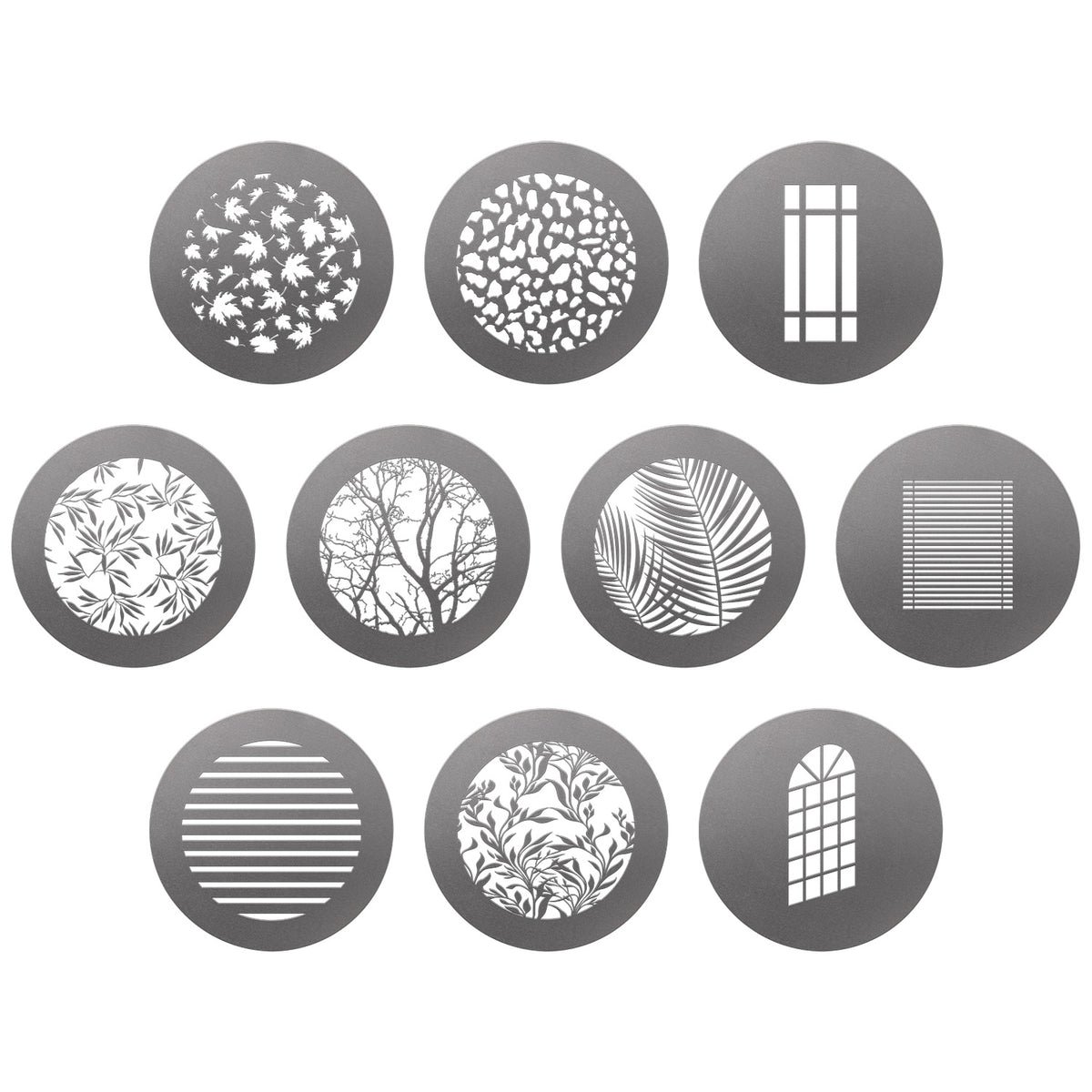
If you've ever walked into an event and seen a company logo glowing on the wall, a monogram projected on a dance floor, or dappled leaf patterns washing across a ballroom ceiling — you've seen a gobo at work. They're one of the most elegant tools in event lighting, and Nashville Audio Visual has been using them to transform spaces since before most of today's planners were booking venues. Here's the full story: what a gobo is, where it came from, what it stands for, and why LED lekos have completely changed the game.
What Does GOBO Stand For?
The word "gobo" has been debated for decades in the lighting industry, but the most widely accepted origin is Goes Before Optics — referring to a metal or glass template that is placed in the optical path of a light fixture to shape or pattern the beam. Some old-timers insist it stands for "Go Between," while others trace it back to film and theatre crews who used the term for any object that blocked or shaped light. Whatever the true etymology, the name stuck, and today "gobo" is the universal term for any patterned insert used inside a lighting instrument.
A Brief History of the Gobo
Gobos trace their roots back to the early days of theatre and film production in the mid-20th century. As stage lighting became more sophisticated through the 1950s and 60s, lighting designers started cutting patterns into thin metal discs and dropping them into ellipsoidal reflector spotlights — the workhorse fixture of the theatre world — to project shapes, textures, and silhouettes onto backdrops and stages.
By the 1970s and 80s, the concert and corporate event industries had adopted gobos widely. Steel gobos were laser-cut with intricate patterns — flames, foliage, geometric designs, window panes, cityscapes — and glass gobos followed, allowing full-color imagery and photographs to be projected (we break down the difference in glass vs. steel gobos). What started as a theatre trick became a cornerstone of professional event production worldwide.
Custom gobos — etched with a company logo or a couple's monogram — became a staple of corporate events and weddings through the 1990s and 2000s. A custom steel gobo is still one of the most cost-effective ways to brand a space or add a personal touch to an event.
What Lights Do Gobos Use?
Traditional gobos are designed for ellipsoidal reflector spotlights, also called ERS fixtures or — in stage lighting shorthand — lekos (named after the Lekolite, the ellipsoidal Century Lighting introduced in the 1930s; "Leko" combines the names of its founders, Joseph Levy and Edward Kook). An ellipsoidal uses a precise arrangement of lenses to produce a sharp, controllable beam of light. Inside that beam path sits the gobo slot — a metal holder that accepts a standard-size gobo disc.
When a patterned gobo is inserted, the light passing through the cutouts or etched areas projects a crisp image onto whatever surface it's aimed at. Rotate the gobo holder and the image rotates. Adjust the focus barrel on the fixture and the projected image sharpens or softens. It's a beautifully simple optical system, and it hasn't changed fundamentally in 60 years — until LED came along.
Enter the LED Leko: The New Standard
For most of their history, ellipsoidal fixtures ran on tungsten-halogen lamps — hot, power-hungry, and fragile. A standard leko pulled anywhere from 575 to 1,000 watts just to produce a focused beam. Color required physical gel filters that faded and burned. Running a full rig of traditional ellipsoidals for a corporate event meant heavy power distribution, significant heat load, and a lot of consumables.
LED lekos changed everything. Modern LED ellipsoidals like the ETC Source Four LED and similar fixtures from manufacturers like Chauvet Professional and ADJ deliver the same sharp, gobo-ready beam at a fraction of the wattage of their tungsten counterparts. More importantly, they include built-in full-spectrum RGB or RGBW LED engines, meaning full color control with no gels required. You can shift from a warm amber tone to a deep blue to a saturated magenta with a single command from a lighting console — no one climbing a ladder to swap filters.
For gobo work specifically, LED lekos are a revelation. The consistent, bright white light source produces clean, high-contrast projections. Some fixtures include motorized gobo wheels, allowing operators to index (rotate) or animate gobos in real time from the console. And because LEDs run cool, there's no risk of burning steel gobos or degrading glass gobos over a long event day.
Why Nashville Audio Visual Does It Best
Gobo projection looks effortless when it's done right and embarrassing when it's done wrong. Getting a sharp, centered logo on a curved wall, at the right distance, with the right focus, in the right color — that takes experience and the right gear. Nashville Audio Visual has been dialing in gobo rigs for Nashville weddings, corporate galas, brand launches, and concerts for 30 years as part of our lighting design and production work.
We carry a full inventory of event lighting, including LED lekos, and source custom glass and steel gobos, so we can design, order, and project a custom logo or monogram for your event with professional results every time. Whether you want your company name glowing on a hotel ballroom wall, a sweeping leaf pattern washing over your reception tent, or a full-color portrait projected behind your keynote stage — NAV has the gear, the crew, and the experience to make it happen.
Gobos are one of those details that guests may not be able to name, but they absolutely notice. Done well, they make a space feel intentional, branded, and unforgettable. That's what Nashville Audio Visual is here for.
Ready to add gobo projection to your next event? Contact Nashville Audio Visual and let's talk about what we can project for you.