
Wedding Lighting in Nashville: Uplighting vs. String Lights vs. Gobos
Three different tools that usually get sold as one line on the quote. Here is what each one does to a room — and to your photos.
Short answer: uplighting changes the color of the room, string lights give it a ceiling, and a gobo puts your name on it. Most Nashville receptions need uplighting. Tall, tented and outdoor spaces need string lights. A monogram gobo is the cheapest way to make a room look like it belongs to you and not to the last forty weddings held in it. Big, plain, tall rooms usually want all three.
We have lit more than 500 weddings in this city — ballrooms, barns, tents, chapels, glass pavilions and back yards — and the question we hear most is not “how much” but “which one do we actually need?” Here is how we answer it.
Uplighting vs. string lights vs. gobos at a glance
| What it does | The problem it fixes | How it’s priced | |
|---|---|---|---|
| Uplighting | Washes walls and columns in color from the floor up | Beige walls and a room that photographs like a Tuesday | Package: $500–$1,500 for 10–20 fixtures |
| String lights | A warm canopy hung from beams, truss or uprights | Tall, tented or outdoor spaces with no ceiling to speak of | Quoted from the layout: run length, support points, crew or pickup |
| Gobo | Projects a monogram, names, a date or a texture onto a surface | A room that could be anybody’s wedding | Quoted with the room; custom artwork made to order |
What uplighting does at a wedding
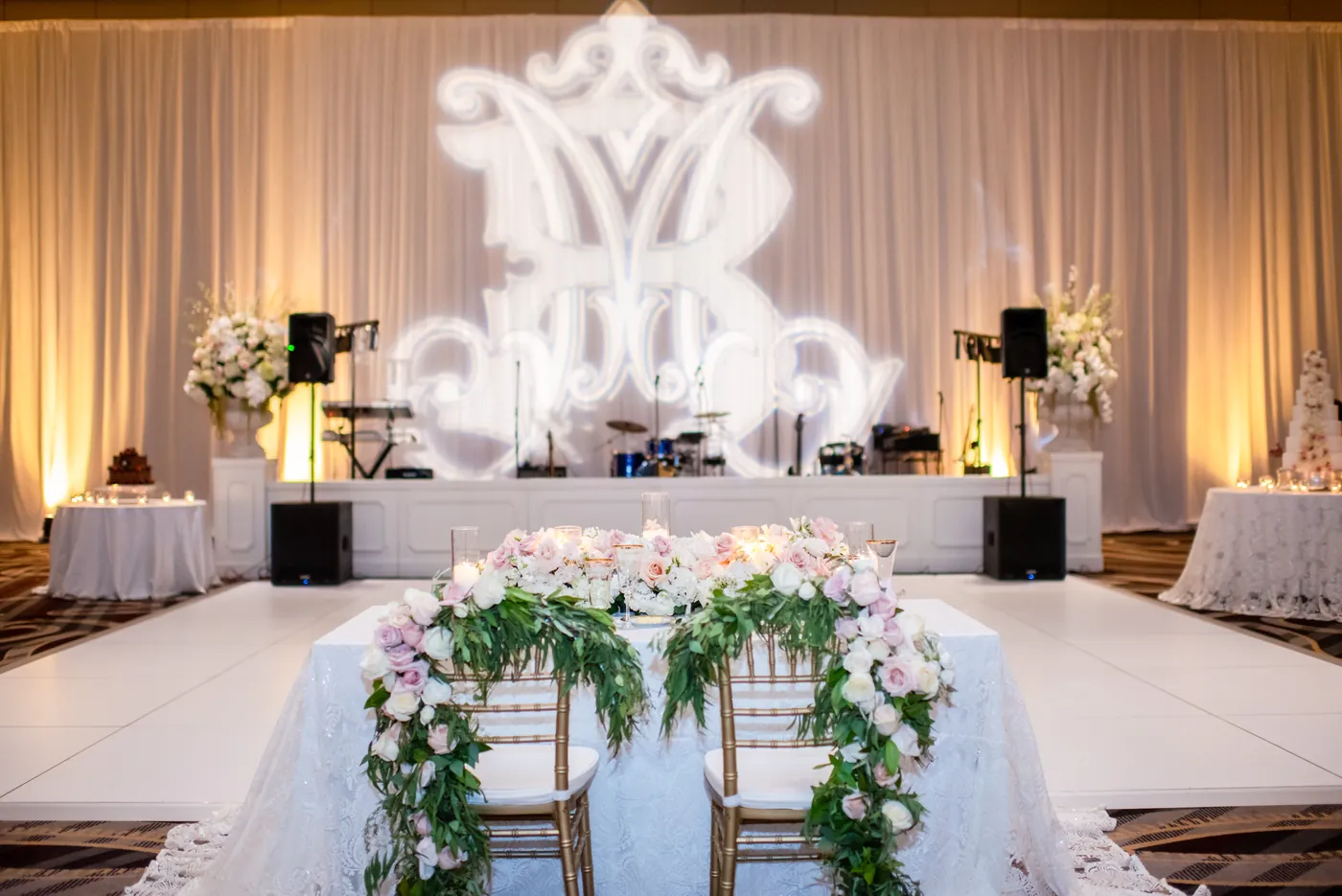
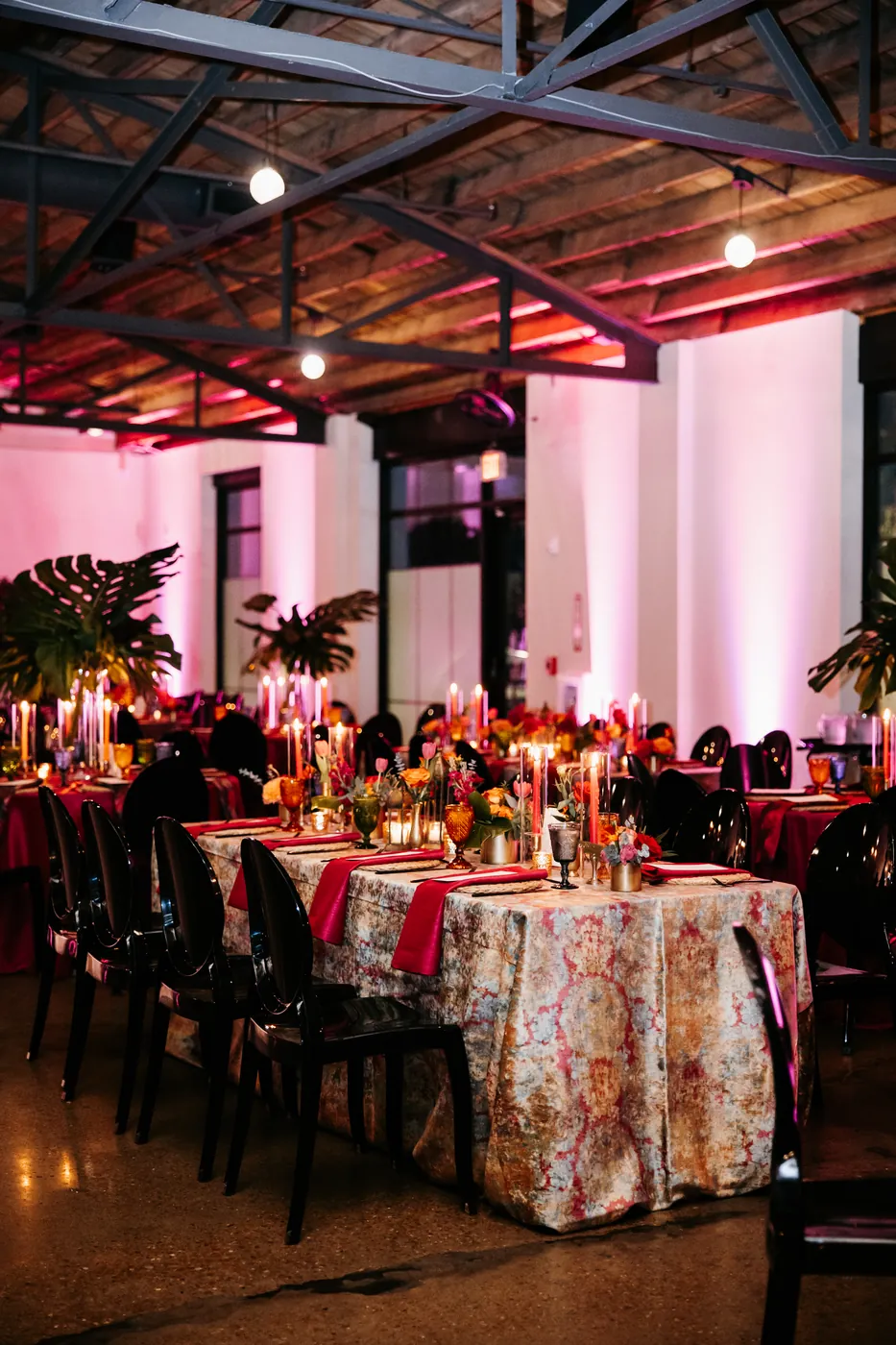
Uplighting is a light on the floor aimed up a wall or a column. It is also the biggest change per dollar in wedding lighting, because the walls are in nearly every photograph, and most venue walls are cream, beige or gray for a reason: they are chosen to go with anything, which in pictures means they go with nothing.
Ours are battery-powered and wireless, so they sit where they look best rather than where the outlets happen to be, and there is no cable across the floor for a guest in heels to find. The rule of thumb is one fixture every 8 to 10 feet of wall you actually want lit: a typical hotel ballroom takes 12 to 20, a smaller reception room 8 to 12. A package of 10 to 20 runs $500–$1,500 — see uplighting and event lighting rental for what is in it.
Ivory, champagne and warm amber read as romance and are kind to skin. Deep blue is drama. Your wedding colors work too, in moderation — a room that is sapphire for the dance floor can feel a little cold at dinner. If you want the room to shift when the dancing starts, that is a cue, and somebody has to be there to run it. Uplights can be set and left, or run live by a technician; it is your call on the quote.
What string lights do (they are a ceiling, not a decoration)
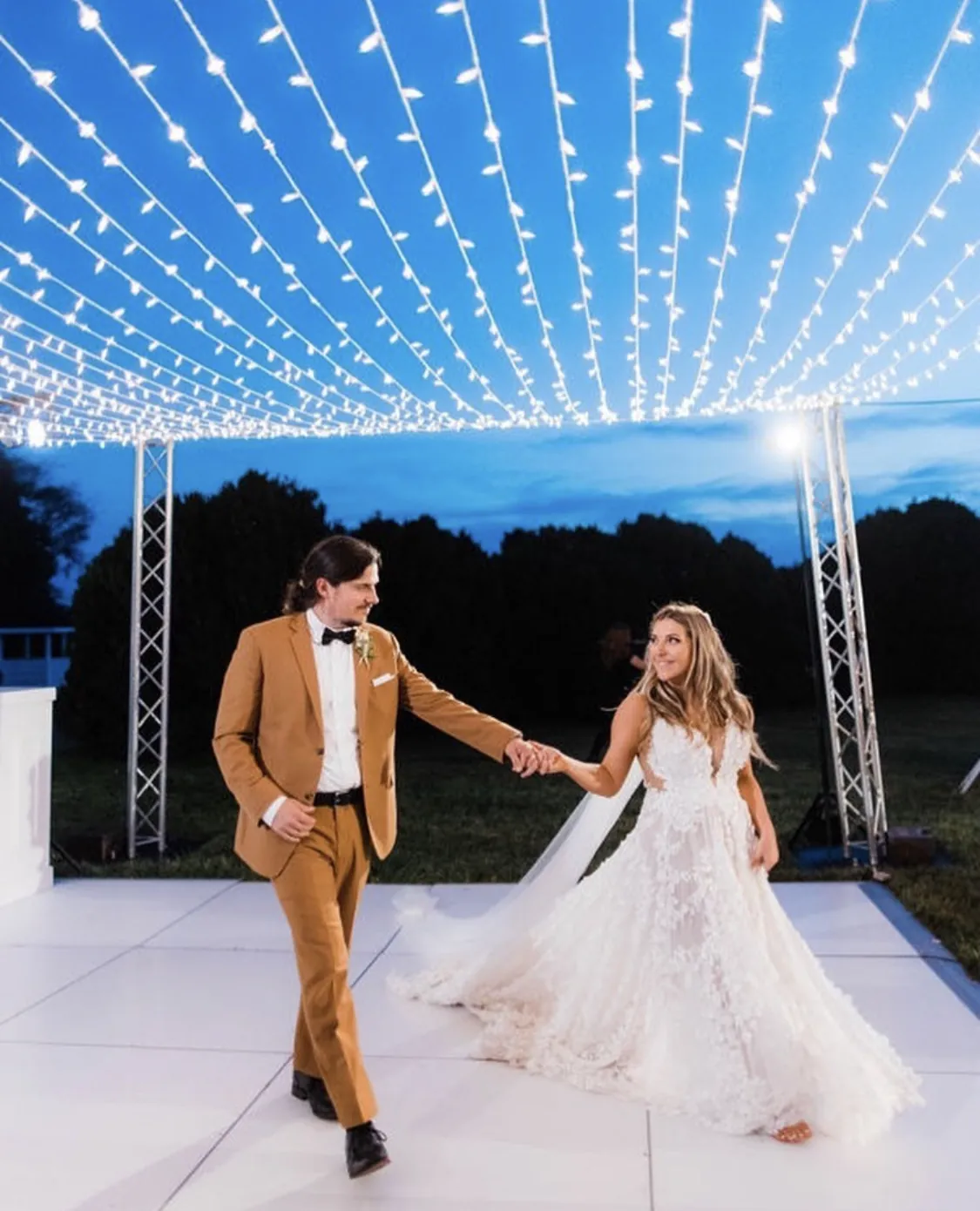
String lights solve a different problem. Uplighting colors the walls; string lights give a room a ceiling. In a barn with open rafters, a tent, a courtyard or a back yard after sunset, the eye drifts up into the dark and the space feels empty no matter how many people are in it. A canopy of warm bulbs pulls the ceiling down to the tables and turns a space into a room.
The layout is the design. Straight parallel runs read clean and formal in a ballroom or a tent. Looser catenary swags feel relaxed over a barn floor or a patio. Vertical drops are for something unusual. We stock Edison-style strands on black or white cord — black for industrial rooms and dark drape, white for tents, white ceilings and light surfaces — plus white LED twinkle lights for draped ceilings and LED rope for outlining a bar. The inventory is on the string lights rental in Nashville page.
Here is what the inspiration photos leave out: string lights are a rigging job. They hang off existing beams, off truss, or off our own uprights, and an outdoor canopy needs weather-protected power runs and a plan for where the power comes from — sometimes our own power distribution. A canopy that sags by the cake cutting, or a dead run over the dance floor, is the most visible failure at a wedding. That is why string lights are priced by the run — how many feet, how many support points, and whether our crew hangs them — and why a photo of your space is the fastest way to a quote.
What a gobo does: your monogram, in light
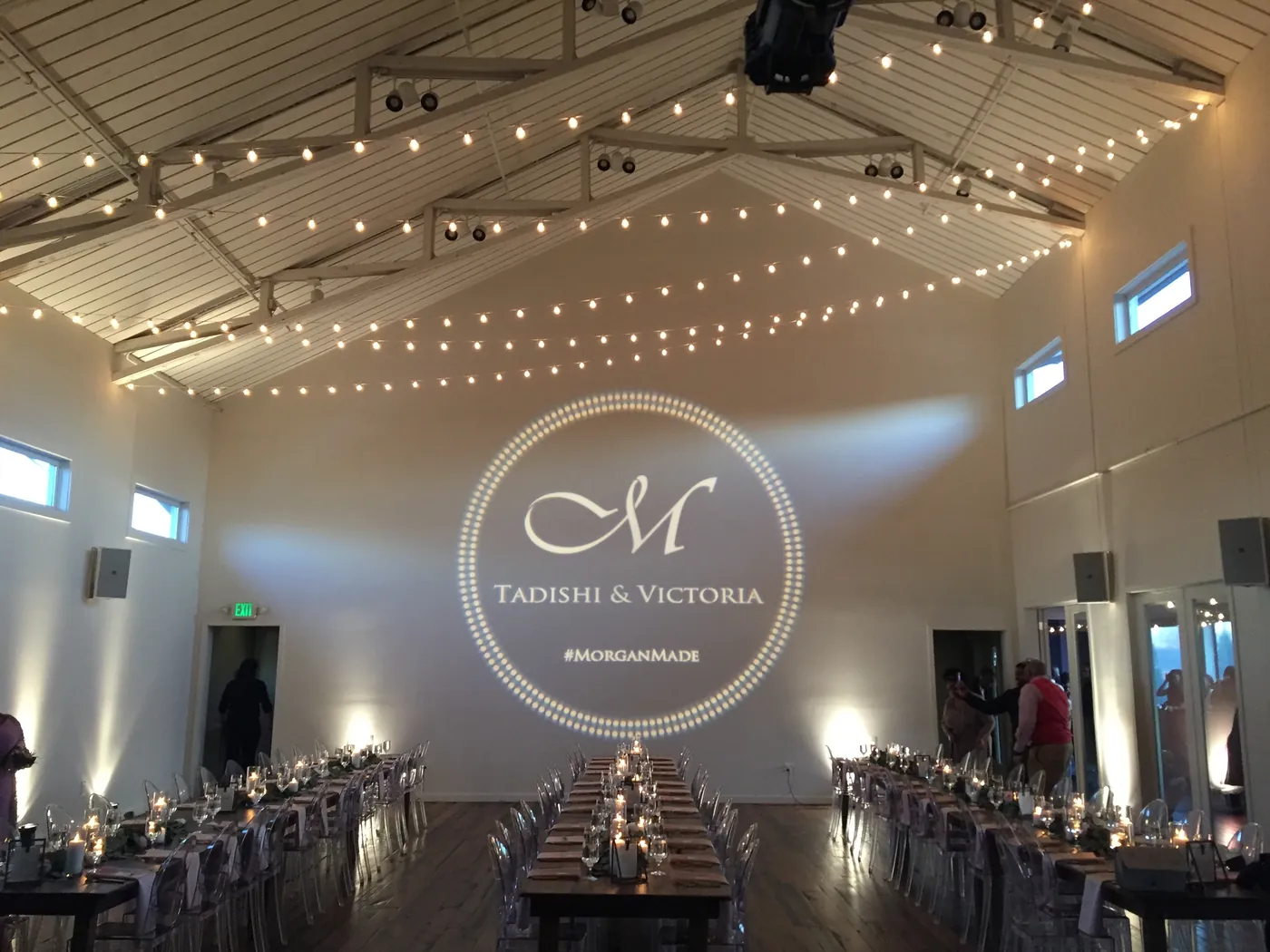
A gobo is a small patterned disc that drops into a focused light, so the fixture projects that pattern onto whatever it is aimed at. At a wedding that usually means your monogram, your names or your date on the dance floor, on the wall behind the head table, or on the drape behind the band. The longer story, including where the word comes from, is in what a gobo is.
It is one of the cheapest ways to make a plain room feel specifically like your wedding, and it is the shot that ends up on everyone’s phone. Three things to know before you order one:
- It is made to order from your artwork. Give us about a week where possible. The night before is not the time to change the font.
- Steel or glass. A steel gobo is a cut stencil: one color, razor-sharp, the classic choice for a monogram. A glass gobo is printed, so it can carry full color, gradients and photographic detail — a crest in your colors, or a moon over the first dance. Glass vs. steel gobos goes deeper.
- It needs a surface. A plain wall, white drape or the dance floor shows it off. A wall of windows or busy brick swallows it.
Which one does your venue need?
Hotel ballroom. Uplighting first. Ballrooms are built to be neutral, and neutral photographs as beige. A monogram on the dance floor or the drape behind the band is the second line. Ceilings are usually low enough that string lights are optional. Ask the hotel early what its AV policy is; in many rooms you can bring your own lighting company — here is how that works.
Barn or industrial venue. Tall rooms with rafters or steel. String lights and chandeliers are what pull the ceiling down; uplights on the columns and beams make the structure part of the design instead of something to ignore. Bring the ceiling down first, then color it.
Tent. A tent is a big white ceiling, which makes string lights the obvious first move: runs along the frame, or a canopy over the dance floor. Uplights on the perimeter add color. Power is the real question, and it gets planned at the site walk, not the morning of.
Outdoor ceremony or back yard. String lights on uprights, trees or the house; battery uplights on trees and hedges, which do more than you would think once the sun goes down. Where there is no power nearby, we bring our own.
Chapel or historic hall. White or stone walls are a gift to uplighting, and a monogram on a plain wall looks like it was always meant to be there.
When you need all three
When the room is big, plain and tall at the same time. A white hall with open trusses, like the one below, is the textbook case: string lights across the trusses give it a ceiling, warm uplights along the walls take the edge off all that white, and a monogram on the end wall tells everyone whose night it is. Each one fixes something the other two cannot.
If the budget covers only one or two, here is the order we usually suggest:
- Uplighting, because it changes every photograph for the least money.
- A gobo, because it is the cheapest way to make the room yours.
- String lights, where the room needs a ceiling — and in a tent or an open-rafter barn, this one jumps to the front of the line.
What wedding lighting costs in Nashville
These come from our published AV rental cost guide and Nashville wedding AV guide, not invented for this post:
- Uplighting package, 10–20 wireless fixtures: $500–$1,500
- String lights, chandeliers and gobo monograms: quoted from the hang — height, span and rigging points drive the labor more than the fixture count
- A fully designed look — uplighting plus chandeliers, a gobo, pin spots and string lighting: typically $2,000–$4,000
- Ceremony sound, if you need that too: a basic PA system starts around $300–$700
You get one itemized quote, so you can see what each piece costs and drop the one you don’t need.
Rent it yourself, or have it hung?
Uplights, small fixtures and string-light strands are available for will-call pickup at our Nashville warehouse, often same day. We set your uplight colors and show you the wireless remote before you leave. That works well for a dozen uplights in a room someone on your side can set, or a strand along a fence line.
Anything that hangs over guests — a string-light canopy across a dance floor or a tent, chandeliers, anything on truss — goes up with our crew. A strand landing on the dance floor is memorable in the wrong way.
Book the lighting when you book the venue
For April, May, September and October — Nashville’s peak wedding months — book at least six months ahead; the rest of the year, at least three. That leaves time to walk the venue, plan the hang and the power, and order a custom gobo without rushing the artwork. We work alongside your planner, florist and caterer: greenery on a chandelier or florals woven into a canopy get sorted at the walk-through, not at three o’clock on the day.
If you would rather someone own the whole look, that is our lighting design service. For the full ceremony-to-last-dance plan, sound included, see wedding AV and lighting.
Wedding Lighting — Common Questions
Is uplighting worth it for a wedding?
For most receptions, yes. The walls are in nearly every photograph, and most venue walls are a neutral color chosen to go with anything. A package of 10 to 20 battery-powered uplights runs about $500–$1,500 from our published cost guide, and it changes the whole room for less than most couples spend on the cake. If the venue already has dramatic walls, or the reception is outdoors in daylight, put the money somewhere else.
How many uplights do I need for a wedding reception?
As a rule of thumb, one fixture every 8 to 10 feet of wall you actually want lit. A typical hotel ballroom takes 12 to 20; a smaller reception room or a private dining room takes 8 to 12. Ours are battery-powered and wireless, so they go where they look best rather than where the outlets are, and there is no cable across the floor for a guest to catch a heel on.
What is the difference between string lights, bistro lights and Edison bulbs?
Mostly the name. All three describe a heavy cord with exposed bulbs spaced along it. Edison refers to the filament-style bulb; bistro and cafe describe the restaurant-patio look. We stock Edison-style strands on black and white cord, plus white LED twinkle lights for draped ceilings and LED rope for outlining a bar or a stage edge.
Can you project our monogram, and how long does a custom gobo take?
Yes. A custom gobo is made to order from your artwork — initials, names, a crest, or your date — so give us about a week where possible. Steel is a cut stencil: one color, very sharp, the classic choice for a monogram. Glass is printed, so it can carry full color, gradients and photographic detail. We project it onto a wall, white drape, the ceiling or the dance floor.
Can I rent string lights and hang them myself?
Strands, cord and basic hardware are available for will-call pickup from our Nashville warehouse, often same day, and that works well for a fence line or a patio. A canopy over a guest floor — anything spanning a tent, a courtyard or a dance floor — we hang ourselves, because a sagging or fallen strand above guests is not a look.
How much does wedding lighting cost in Nashville?
From our published ranges: an uplighting package of 10 to 20 fixtures runs about $500–$1,500. String-light ceilings, chandeliers and custom gobo monograms are quoted from the room, because height, span and rigging points drive the labor more than the fixture count. A fully designed look — uplighting plus chandeliers, a gobo, pin spots and string lighting — typically lands around $2,000–$4,000. You get one itemized quote, so you can see each piece and drop the one you don't need.
Tell Us the Room, We’ll Tell You What It Needs
Send the venue, the date, and a photo of the room — or of a room you loved. We will come back with which of the three you actually need and one itemized quote. Call 615-988-4554 or use the form.
Get a Wedding Lighting Quote